AI development company that ships production AI in weeks
Rapide Technologies is an AI development company that builds AI agents, computer vision systems and AI SaaS products for startups and growing companies in 12 countries. Our engineering team works from Lahore, Pakistan. You see a first working milestone within 48 hours on average, and most projects go live in 2 to 4 weeks for 2,500 to 8,000 US dollars.
35 verified projects. 6 live AI products you can open today. 100% Job Success Score on Upwork.
Top Rated agency on Upwork, rated 5.0/5 across 15+ completed contracts. NDA signed before the first call if you ask.
35
verified projects
6
live AI products
100%
Upwork Job Success
48-hour
first milestone
12 countries
Clients in
Last updated November 2026. Reviewed by Abdul Rehman, CEO and Lead AI Engineer.
What does an AI development company do?
An AI development company plans, builds and maintains software that learns from data or uses large language models to read, write and take actions. The job has five parts: picking a use case that pays back, preparing the data, building or adapting the model, connecting it to the tools your team already uses, and keeping it accurate after launch.
Most companies have already started. McKinsey’s 2025 State of AI survey found 88% of organizations use AI in at least one business function, up from 78% a year earlier. Only about a third have started scaling it across the company. The rest are still in pilots.
That gap is where we work. Across 35 projects, the pattern has held: the demo is the quick part. The real work comes after, like reading Arabic license plates that standard OCR engines can’t, or making sure a billing pipeline can never charge a customer twice. That second kind of work is what clients hire us for.
On this page
AI development services we offer
We cover strategy, data, models, integration, deployment and support under one contract. Most clients start with one small build, often under 5,000 dollars, and add the next once it pays for itself. Scope and prices for each service are on our AI development services page.
Custom AI software development
AI software built around your workflow, your data and your rules. Example: Syauctus AI, a live platform that helps hospital documentation teams review inpatient charts and catch DRG coding gaps. Every suggestion cites the exact line in the medical record, and a specialist approves it.
AI agent development and workflow automation
Agents that read documents, make decisions within set limits and act in your business tools. Example: a multi-tenant operations engine for a logistics and waste company in Australia and the UK that runs its accounts, support, sales and management reporting. Claude reads messy supplier invoices, but it never writes to the accounting system directly. Deterministic checks validate every figure before anything changes.
Generative AI and voice AI development
Text, voice and image generation. Example: AI Sanctuary recreates a person’s voice with ElevenLabs and holds conversations through Claude, drawing on life stories stored in a pgvector memory. Another build, Brandelo, turns one product photo into a set of on-brand ad creatives for each social platform.
RAG, AI memory and private LLM development
Assistants that answer from your own documents or remember users across months, and models that run entirely inside your building. Example: a clinical assistant with a fine-tuned open-weight model running locally on Ollama, plus X-ray anomaly detection and dual OCR for medical reports. No patient data is sent to the cloud. NV Companion uses vector memory to recall a user’s goals and setbacks across coaching sessions.
AI chatbot and conversational AI development
Support bots, voice ordering and training simulators. Examples: a customer support chatbot and social media sentiment pipeline for TechieNet; a browser-based restaurant voice ordering agent that replies in under 600 milliseconds with no telephony fees; and Persona Pitch, a voice simulator where sales reps practice against AI buyer personas such as a skeptical CFO.
Document AI and OCR
Invoices, receipts, resumes and medical reports turned into structured data. Example: HireIQ reads hundreds of PDF resumes directly with Gemini 2.5 Flash and scores each candidate from 0 to 100 against a written rubric, quoting the resume line behind every point. Shortlisting dropped from days to under 10 minutes.
Machine learning and predictive analytics
Forecasting, risk scoring and anomaly detection. For these jobs, classic ML is often more accurate than a large language model and far cheaper to run. Examples: Stock AI PSX for Pakistan Stock Exchange screening, Clout for employee retention risk, and a crash-risk API that scores any location across 400 MB of accident records in under 200 milliseconds.
Computer vision and edge AI development
Detection, inspection and recognition from cameras, drones and phones. Examples: a parking gate system live at a commercial facility in Saudi Arabia (99.2% vehicle detection, Arabic and Roman plate reading at 96% mAP50, gate opens in under 2 seconds); RoadEye, which finds potholes in 4K drone video and tags each one with GPS coordinates; and DermaSense, which detects skin lesions in real time on a standard clinic desktop.
AI mobile app development
Native iOS apps in Swift and SwiftUI, and cross-platform apps in Flutter, with AI built in. Examples: an asbestos screening app that gives site inspectors a risk score from a photo, an offline-first iOS field app for a German enterprise, and a mobile voice cloning app.
AI integration with your business systems
We connect AI to the tools you already run. Systems we’ve integrated in client projects: Xero, GoHighLevel, Mailgun, Google Drive, Google Calendar, Twilio, Stripe and Supabase, plus physical hardware through Arduino controllers.
AI consulting and architecture assessment
An independent review of your architecture, data and AI plans before you commit budget. For one digital consulting firm, we delivered the assessment within 48 hours: the risks we found, how to fix them, and a phased rollout plan. Assessments are priced as a fixed fee or by the hour, quoted before you book.
AI MVP development for startups
A working product in front of users quickly. One founder asked for a basic setup and got user accounts, an AI chatbot, Stripe billing and PDF invoicing, deployed on AWS in 12 days.
AI development cost and timelines in 2026
Most Rapide projects cost 2,500 to 8,000 US dollars and take 2 to 4 weeks. Our range runs from 800 dollars for a focused automation to 15,000 dollars for a multi-tenant enterprise platform. We cost less than most US and European agencies because our engineering team is based in Lahore, Pakistan. The stack and the engineering standards are the same.
How much does AI development cost? Prices by project type
|
Project type |
Build cost (USD) |
Typical timeline |
Recent example |
|---|---|---|---|
|
Focused automation or document AI |
800 to 2,000 |
1 to 2 weeks |
Invoice OCR pipeline, appointment reminder agent |
|
AI MVP for a startup |
2,000 to 4,000 |
2 to 3 weeks |
AI SaaS MVP shipped in 12 days |
|
Chatbot or voice assistant |
1,500 to 5,500 |
2 to 4 weeks |
TechieNet support bot, restaurant voice ordering |
|
Computer vision system |
2,500 to 7,500, plus any hardware |
2 to 4 weeks |
Saudi parking access system, RoadEye, DermaSense |
|
AI agent or document AI platform |
3,500 to 5,500 |
About 3 weeks |
HireIQ resume screening |
|
Full AI SaaS product (web and mobile) |
4,500 to 12,000 |
5 to 8 weeks |
NV Companion, Clout, AI Sanctuary, Syauctus AI |
|
Enterprise multi-tenant platform |
8,000 to 15,000, plus a monthly retainer |
About 12 weeks |
Logistics operations engine |
|
Architecture and strategy assessment |
Fixed fee or hourly |
48 hours |
Architecture review for a consulting firm |
Swipe sideways to see the full table
Ranges come from our signed contracts. Third-party costs such as model APIs, hosting and hardware are listed separately in your quote and billed at cost. Smaller project? Ask anyway.
What it costs to run each month
The build is a one-time cost. Running the system is a monthly one, and it surprises buyers more than anything else. We put the estimate in writing before you sign.
|
Running cost |
What drives it |
How we keep it down |
|---|---|---|
|
Model usage (tokens or API calls) |
Number of requests, length of each, which model |
Smaller models for easy requests, cached answers, local open-weight models where privacy or volume justifies it |
|
Hosting and database |
Data volume, traffic, uptime needs |
Run in your own cloud account, or on site when the job allows |
|
Monitoring and support (optional) |
How often we test accuracy, response time you need |
Monthly retainer, cancel any time |
Swipe sideways to see the full table
Some systems cost almost nothing to run. The Saudi parking system uses no cloud servers and no software licenses; everything runs on site. Across the industry, monthly operating costs range from a few hundred dollars to tens of thousands, depending on traffic, model choice and token usage (Miquido, 2026). Your quote shows where your system is likely to sit.
What drives AI development cost: 8 factors
1. Data readiness. Clean, labeled data lowers cost. Messy data adds time.
2. Model choice. Adapting an existing model costs far less than training one from scratch.
3. Number of integrations. Each connected system adds scope and testing.
4. Autonomy level. A tool that suggests is cheaper than an agent that acts on its own.
5. Compliance load. Healthcare privacy, GDPR and audit trails add engineering work.
6. Platforms. Web only costs less than web plus native iOS and Android.
7. Hardware. Edge projects add device costs. The parking system’s camera, controller and gate motor cost under 2,000 SAR (about 525 dollars).
8. Support plan. Monitoring and updates keep accuracy up after launch.
Model prices keep falling. Stanford’s AI Index 2025 reports that the cost of running a model at GPT-3.5 level dropped more than 280-fold between November 2022 and October 2024. Most of your budget goes to data and integration work. If a vendor quotes you a price without asking about your data, get a second quote.
Custom AI vs off-the-shelf tools, freelancers, large consultancies or an in-house team
You don’t always need us. Off-the-shelf tools fit generic tasks. An in-house team fits companies where AI is the product itself. Custom development fits when your workflow is your advantage and no tool matches it. Here are the trade-offs.
|
Factor |
Off-the-shelf tool |
Freelancer |
Rapide (custom build) |
Large consultancy |
In-house team |
|---|---|---|---|---|---|
|
Upfront cost |
Low |
Low to medium |
Low to medium: most projects 2,500 to 8,000 dollars |
High |
Very high |
|
Monthly cost |
Per seat, grows with headcount |
Hourly |
Hosting plus optional retainer |
Retainers |
Salaries for several engineers |
|
Time to first value |
Days |
Varies with the person |
First milestone in 48 hours; most projects live in 2 to 4 weeks |
Slower; long discovery phases |
6 to 12 months to hire and build |
|
Fit to your workflow |
Rough |
Depends on the person |
Exact |
Exact |
Exact |
|
Production engineering (testing, monitoring, security) |
Vendor’s choice |
Often missing |
Included |
Included |
You must hire for it |
|
Your data control |
Vendor’s terms |
Check the contract |
Full |
Check the contract |
Full |
|
IP ownership |
None |
Check the contract |
Yours |
Check the contract |
Yours |
|
If a key person leaves |
Vendor’s problem |
Project stops |
Team and documentation cover it |
Team covers it |
Your risk |
Swipe sideways to see the full table
Pick a tool when the job is generic. Pick us when your workflow is what sets you apart. Build in-house when AI is your product and you can wait a year to hire. We say this on sales calls too. It costs us some deals, and the clients who do fit tend to stay: our longest engagement, a logistics operations platform, has run for multiple years.
The technology we use, and how we choose it
Every tool below is in a system we’ve delivered. We pick by testing on your use case, and if a cheaper option does the job just as well, we use it.
|
Layer |
What we use |
Where it’s earned its place |
|---|---|---|
|
Large language models |
Claude, Gemini 2.5 Flash, OpenAI GPT models, open-weight models on Ollama |
Commercial APIs for quality; local models when data can’t leave your building |
|
Voice AI |
ElevenLabs, OpenAI Whisper, Web Speech API |
Voice cloning, speech-to-text, browser voice ordering under 600 ms |
|
Agents and automation |
n8n, LLM function calling, FastAPI services |
Multi-step workflows with validation before any write |
|
Computer vision |
YOLOv5, YOLOv8, custom CNNs, OpenCV |
Drone inspection, plate reading, skin lesions, facial asymmetry scoring |
|
Document AI |
Tesseract, EasyOCR, multimodal LLMs |
Invoices, resumes, medical reports |
|
Classic machine learning |
scikit-learn, Pandas, NumPy, time-series models |
Fraud detection, retention risk, stock screening, forecasting |
|
Data and memory |
Supabase, PostgreSQL, pgvector, MySQL, SQLite |
Records, semantic memory, tenant isolation |
|
Backend |
Python, FastAPI, Flask, Node.js, Express |
APIs and AI services |
|
Web and mobile |
Next.js, React, Flutter, Swift, SwiftUI |
The product around the AI, which decides whether people use it |
|
Edge and IoT |
Arduino, RTSP IP cameras, local inference |
AI that controls physical hardware |
|
Cloud and delivery |
AWS, Vercel, Docker, Stripe |
Deployment, billing, scaling |
Swipe sideways to see the full table
Built for AI agents: MCP, A2A and agent-ready systems
Buyers now ask a new question: will this work with AI agents? Two open standards answer it.
We design new systems so AI assistants can use them safely: clear APIs, a permission layer that separates reading from writing, and a log of every action. Where it fits, we expose your systems through MCP servers. The rule from our enterprise operations engine carries over to every agent we build: the model proposes, deterministic code checks, and only then does anything change.
How we secure AI agents and LLM apps
An AI system that reads documents and calls tools has risks ordinary software doesn’t. We use the OWASP Top 10 for LLM Applications as our checklist. Here is how that looks in systems we’ve shipped.
Why companies choose Rapide as their AI software development company
Four claims, each one you can check before you sign.
Engineers you can name and check
Every proposal lists the engineers who will build your system, with LinkedIn profiles and past work. The people on the proposal are the people on the project. If someone has to change, you approve the replacement.
A record you can verify in five minutes
35 verified projects across 9 industries and 12 countries. Six live AI products you can open right now. A 100% Job Success Score and a 5.0 rating across 15+ Upwork contracts, with Top Rated agency status. Each claim links to its source.
Published prices, fast delivery, full IP ownership
Prices are on this page; most projects cost 2,500 to 8,000 dollars. The first working milestone arrives in 48 hours on average. You own the code, the prompts and any model we fine-tune for you, and our name appears nowhere in your IP.
One accountable team
Strategy, data, build, deployment and support sit under one contract, with one lead engineer as your main contact. Our team works on Pakistan Standard Time (UTC+5), which overlaps with business hours in the Gulf, Europe and the UK, and we schedule calls to suit US time zones.
Security, compliance and data privacy
Your data never trains shared models, and every access to it is logged. The details are below, and the same commitments go into your contract.
Your private data
Access follows least-privilege rules, and reads and writes are logged. Where the model provider offers it, we switch on no-retention API settings so prompts and outputs aren’t stored on their side. Every contract includes an NDA and a data processing agreement (DPA).
Certifications
Rapide doesn’t hold ISO 27001 or SOC 2 certification yet. ISO and security audits are in progress. Until then, we can run your system entirely inside your own infrastructure, so your data never touches ours. We align our build process with the NIST AI Risk Management Framework.
Healthcare and EU privacy
For healthcare clients, we’ve built systems where patient data never leaves the clinic: our clinical assistant runs its language model locally on Ollama, with no external API calls. For EU clients, we build to GDPR requirements, as in the offline-first iOS app for a German enterprise that stores field data locally and syncs securely.
EU AI Act readiness
The EU’s Digital Omnibus on AI, in force since July 2026, moved the obligations for stand-alone high-risk AI systems (hiring tools, credit scoring and similar uses) to 2 December 2027. AI built into regulated products, such as medical devices, follows on 2 August 2028. Transparency duties, like telling people they’re talking to an AI, apply from 2 August 2026. Several of our builds touch these areas, including resume screening and clinical tools, so we classify your use case during discovery and design human review into the system. The full text of the EU AI Act (Regulation (EU) 2024/1689) is on EUR-Lex.
Deployment your way
Your own cloud account, on-premise servers (like the clinical assistant), or edge hardware at your site (like the Saudi parking system, which runs with no external servers). Either way, you hold the keys.
Meet the engineers who build your system
We name the people who build your system, and these are the people you’ll talk to every week.
Abdul Rehman
CEO and Lead AI Engineer
Leads scoping, system architecture and delivery, and reviews the technical content on this site.
Fatima
Data Science Lead
Leads data preparation, predictive modeling and model evaluation.
AI development experience across 9 industries
A retention-risk model and a skin-lesion detector share almost nothing except the math, so each industry’s rules shape the build. Every row below names delivered projects.
|
Industry |
What we’ve built |
Projects |
|---|---|---|
|
Healthcare and clinical AI |
Skin lesion detection, epilepsy screening, facial paralysis scoring, a private clinical LLM with X-ray analysis, DRG documentation review, biomedical research analytics |
DermaSense, EpiDetect, Rapide Medical Assistant, Facial Paralysis Detection, Syauctus AI, Basel clinical research |
|
Smart infrastructure |
4K drone road inspection, camera-based parking access on real gate hardware, 30-day crash-risk forecasting |
RoadEye, Automated Parking Access (Saudi Arabia), Accident Prediction Pipeline |
|
Enterprise operations and logistics |
Multi-tenant automation of accounts, support, sales and reporting; invoice OCR; architecture reviews |
Logistics operations engine (Australia and UK), Invoice OCR, AI architecture assessment |
|
Finance and fintech |
Stock screening, news sentiment indicators, fraud detection, automated bank and invoice reconciliation |
Stock AI PSX, News Sentiment Analyzer, fraud detection model, operations engine |
|
HR tech |
Retention-risk analytics and bulk resume screening with cited scores |
Clout, HireIQ |
|
Construction and safety |
Asbestos risk screening from a phone photo, on-site material tracking |
Asbestos Detection App, Material Construction App |
|
Hospitality and food service |
Voice ordering with live delivery ETAs, conversational meal planning |
Restaurant Agentic AI, Flavour Fellow |
|
eCommerce and retail |
Competitor price and search ranking tracking, generative ad creatives |
Crystal Commerce Dashboard, Brandelo |
|
Media, EdTech and consumer AI |
Voice and memory preservation, voice journaling, AI coaching, sales roleplay, chess vision, voice cloning |
AI Sanctuary, Remirro, NV Companion, Persona Pitch, AstroAI, AI Chess Vision, voice cloning app |
Swipe sideways to see the full table
Results from AI systems we’ve shipped
Every result below is a measured number from a delivered system. Where an NDA applies, we name the industry and country instead of the client.
Saudi parking facility: vehicles through the gate in under 2 seconds
A commercial facility operator in Saudi Arabia needed to replace manual guard checks at its vehicle gate. Standard OCR engines can’t read Arabic license plates, and commercial plate-recognition systems cost far more than the site could justify. We trained a YOLOv8 vehicle detector and a custom OCR model for Arabic and Roman plates, then wired the system to an Arduino-controlled gate motor. Result: 99.2% vehicle detection, 96% mAP50 on plate reading, and gate entry in under 2 seconds, live on real hardware. Build time: 3 weeks. Hardware cost: under 2,000 SAR (about 525 dollars). Hardest problem: training OCR that handles Arabic script and Roman characters on the same plate.
HireIQ: candidate shortlisting from days to under 10 minutes
A recruitment client was buried in hundreds of resumes per role, and keyword filters were rejecting good candidates. We built HireIQ on Node.js and Gemini 2.5 Flash. It reads PDF resumes directly, scores each candidate from 0 to 100 against a written rubric, and explains every accept or decline. Result: shortlisting time dropped from several days to under 10 minutes per batch. Build time: 3 weeks. Hardest problem: stopping vague AI verdicts. The prompts require the model to quote the exact resume line behind every point it awards.
Logistics and waste operations, Australia and UK: four departments on one autonomous engine
This client’s accountants spent weeks matching supplier invoices against driver logs, and customer billing ran late as a result. We built a multi-tenant engine on n8n, Supabase and Claude, connected to Xero, GoHighLevel, Mailgun and Google Drive. Result: accounts, support, sales and management reporting now run on automated pipelines, with human audit gates and no duplicate transactions across tenants. Initial build: 12 weeks, followed by a multi-year retainer. Hardest problem: tracing intermittent memory crashes in high-volume runs back to their cause using execution-ID logs.
Restaurant voice ordering: replies in under 600 milliseconds
Restaurants miss phone orders at peak times and pay heavy commissions to delivery apps. We built a browser-based voice ordering agent with Gemini 2.5 Flash, FastAPI and Supabase that takes orders, handles mid-sentence changes, calculates delivery ETAs and streams PDF invoices with QR codes. It also gives managers a voice-driven sales dashboard. Result: voice replies in under 600 milliseconds on the production test setup, with no telephony fees. Build time: 2 to 3 weeks. Hardest problem: updating the cart when a customer changes their mind mid-order without restarting the conversation.
Six AI products you can open right now
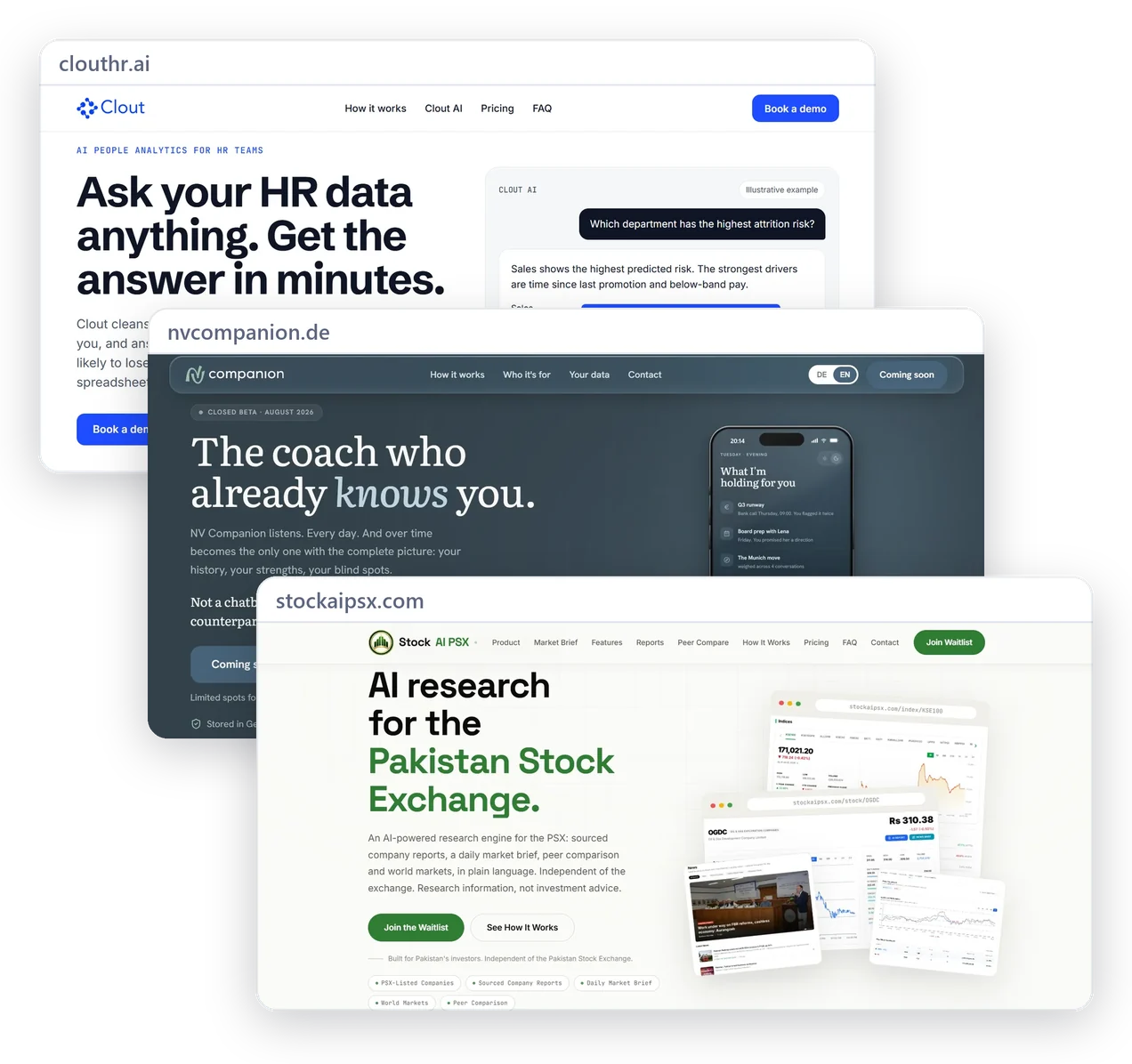
AI Sanctuary, Remirro, Clout, Stock AI PSX, NV Companion and Syauctus AI are live products we built for their owners. Open any of them and see the work for yourself.
Our data: what 35 AI projects tell us
These numbers come from Rapide’s own delivery records (October 2026) and are updated every year. Journalists and researchers may cite them with a link to this page.
Projects verified:
35
across 9 industries and 12 countries
Median timeline from kickoff to delivery:
3 weeks
(shortest 48 hours, longest 12 weeks)
Median project value:
about 3,900 US dollars
(midpoints of contract ranges); most projects fall between 2,500 and 8,000
Average time to first working milestone:
48 hours
Projects still live and maintained today:
6 SaaS products
Most common technical domain:
computer vision
in 9 of 35 projects
Why most AI projects fail, and how we lower the risk on yours
The research is blunt. MIT’s Project NANDA reported in 2025 that 95% of enterprise generative AI pilots showed no measurable profit impact. RAND found that more than 80% of AI projects fail, about twice the rate of other IT projects. S&P Global found that 42% of companies abandoned most of their AI initiatives in 2025. Gartner predicts that over 40% of agentic AI projects will be canceled by the end of 2027 because of rising costs, unclear value or weak risk controls.
All four point to the same place. Projects fail during execution, and the model is rarely the cause. Here are the five failure patterns we see most, and what we do about each.
Bad data in, bad AI out
We check your data before any model work. In the Accident Prediction Pipeline, rural roads with few recorded crashes would have looked falsely safe, so we added statistical smoothing before scoring. If your data isn’t ready, we tell you.
Pilots that never reach production
The first milestone, delivered within 48 hours on average, runs on the same stack that will serve real users. Moving from pilot to launch means adding users and integrations, with no rebuild in between.
Systems that fail silently
We log every step. In the logistics operations engine, every pipeline run, API call and validation decision is recorded against an execution ID, which is how we traced and fixed problems no test had caught.
Nobody uses it
Real users try the system from the first milestone, and we change it based on what they do. A system nobody uses is a failure with good uptime.
An agent where a simpler system would do
Gartner estimates only about 130 of the thousands of vendors selling agentic AI offer real agentic products, and says many use cases sold as agentic don’t need agents at all. We recommend the simplest system that does the job. Our invoice OCR pipeline, for example, uses two proven OCR engines and no language model, and it cost the client under 1,500 dollars.
How we take an AI idea to production in 2 to 8 weeks
Most projects take about 3 weeks. Full SaaS products take 5 to 8, and multi-tenant enterprise platforms around 12. You see working software throughout, starting within days.
1. Scoping call and fixed quote (days 1 to 2)
We agree on one outcome to build first, check your data, and send a fixed quote with every cost listed.
2. First working milestone (within 48 hours on average)
A working slice of the system running on real data, so you can judge direction before most of the budget is spent.
3. Build on your data (weeks 1 to 3)
The full build, with test cases from your own examples and guardrails such as human approval for high-risk actions.
4. Deploy and integrate (weeks 2 to 4)
Launch in your cloud, on your servers or on site hardware, connected to your tools, with documentation and a handover session.
5. Support and improve (ongoing, optional)
A monthly retainer covers monitoring, fixes and new features. Our longest-running retainer has continued for multiple years.
Engagement models
Fixed-price projects
Fixed scope, fixed price and a delivery date in the contract. Most clients start here, typically with a 2,500 to 8,000 dollar first build.
Monthly retainer
Ongoing development, operations and support for live systems, billed monthly. Suited to products that keep growing after launch.
Technical advisory
Architecture reviews and AI strategy sessions, billed hourly or as a fixed fee. One recent assessment was delivered within 48 hours.
Verified client reviews
We hold a 100% Job Success Score and a 5.0 rating across 15+ completed Upwork contracts, with Top Rated agency status. A few of the reviews:
“The Rapide Technologies engineering team led the development of an AI chatbot for customer support and a social media sentiment analysis tool. Their expertise in ML and LLMs, combined with strong leadership and problem-solving skills, were crucial to the project’s success. Highly recommended for AI-driven initiatives.”
Rejwan Bin Sulaiman, CEO and Founder, TechieNet
“Working daily with Rapide Technologies, I’ve gained a deep respect for their data science capabilities through their expertise in building production systems and solving complex engineering problems. Their technical leadership and contributions have been invaluable to my team. This is a glowing review that still falls short of expressing my full appreciation.”
Case Bloom, Owner, TuckerBloom US
“Excellent work by Rapide Technologies on this project. I originally asked for a basic setup, but they went well beyond what was requested, adding secure authentication, Stripe billing, and clean PDF invoicing in under two weeks. Highly recommend Rapide Technologies for any AI SaaS build.”
Founder and CEO, early-stage AI venture (verified Upwork review)
“Rapide Technologies did an exceptional job building our AI candidate screening platform. They delivered a complete, high-performance web application that exceeded our expectations. The candidate scoring rubric is transparent, the interface is fast, and our team saved days of manual review.”
Hiring manager, enterprise recruitment agency (verified Upwork review)
“Rapide Technologies did an excellent job on this OCR project. The team not only delivered a highly accurate script combining two OCR engines, but also provided clear documentation and handled all our format edge cases cleanly.”
Finance manager, corporate accounting client (verified Upwork review)
Frequently asked questions about AI software development
Get a free AI project estimate in 24 hours
Tell us what you want to build. A senior engineer replies within one business day with a cost range, a timeline and the three biggest risks we see in your project.
We reply within 24 hours on business days. Ask for an NDA before you share anything sensitive. We won’t add you to a newsletter.
Sources
- McKinsey, The State of AI in 2025
- Stanford HAI, AI Index Report 2025
- Fortune, MIT report: 95% of generative AI pilots at companies are failing (August 2025)
- RAND Corporation, The Root Causes of Failure for Artificial Intelligence Projects (2024)
- CIO Dive, S&P Global data on AI project abandonment (2025)
- Gartner, Over 40% of Agentic AI Projects Will Be Canceled by End of 2027 (June 2025)
- Miquido, AI App Development Costs Guide (2026)
- EU AI Act, Regulation (EU) 2024/1689
- OWASP Top 10 for LLM Applications
- NIST AI Risk Management Framework